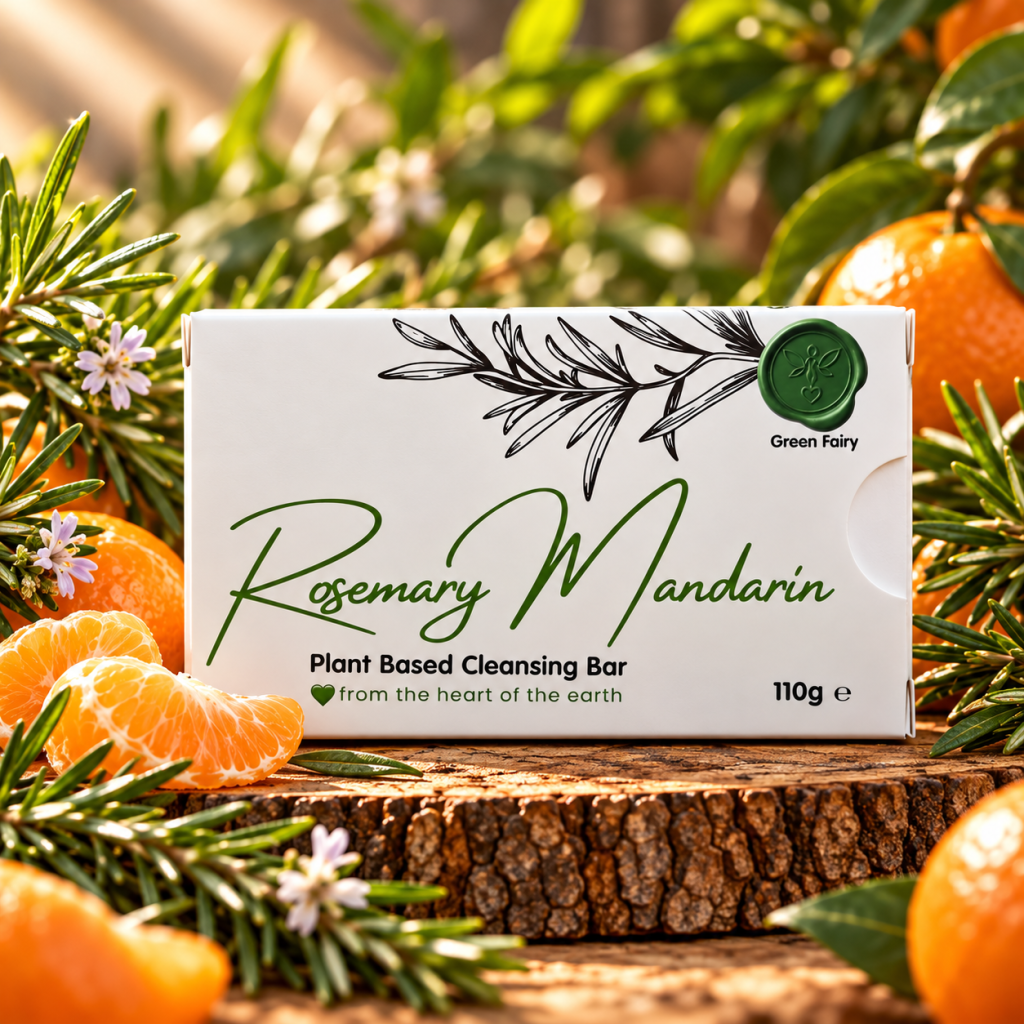
A Soap Maker’s Perspective A Soap Maker’s Perspective
Discover the difference between handmade botanical soap and commercial cleansing bars, and why understanding what goes into your soap matters.
Have you ever stepped out of the shower, dried yourself off and felt that your skin was tight, dry or uncomfortable? Or perhaps you’ve started paying closer attention to the ingredients in your personal care products and wondered whether there is a more natural alternative.
For me, the journey towards natural personal care began long before Green Fairy Products existed.
As a qualified aromatherapist who has worked in the holistic health space since 2005, I’ve always been fascinated by the relationship between plants, essential oils and our everyday wellbeing. My interest in soap making began even earlier, when I was a teenager experimenting with glycerine soap after buying a book on the subject.
What started as curiosity gradually became something much more meaningful. I wanted to create products for myself and my children that reflected my values, allowed me to understand exactly what I was using on my skin, and brought the beautiful world of aromatherapy into everyday life.
Since developing Green Fairy’s soap range, I’ve spent years learning, experimenting and refining my formulations. Today, I also teach others the fundamentals of cold-process soap making, empowering them to understand the ingredients and science behind the products they create.
So, is natural handmade soap better than commercial soap?
My answer is that it depends on the formulation. But when a bar is made with quality ingredients, carefully balanced oils and a good understanding of soap chemistry, it can offer a very different experience from many conventional cleansing bars.
Let’s explore why.
1. Not All Soap Bars Are Actually Soap
This is one of the most interesting things I’ve learnt through my work as a soap maker.
The word soap is commonly used to describe almost any solid cleansing bar. However, there is an important distinction between traditional soap and synthetic detergent bars.
Traditional soap is made through a chemical process called saponification. This happens when oils or fats react with an alkali, usually sodium hydroxide, to produce soap and glycerol.
Synthetic detergent bars, often called syndet bars, use synthetic cleansing agents known as surfactants. These ingredients help water mix with oils and dirt so they can be rinsed away.
Neither category is automatically good or bad. Both can be formulated effectively, and both can be unsuitable for certain skin types depending on their ingredients and cleansing strength.
What matters is understanding what you are buying.
When choosing a bar, I encourage people to look beyond the front label and become familiar with the ingredient list. Is it a traditional soap? A detergent bar? What oils, cleansing agents, fragrances and other ingredients does it contain?
The more you understand your products, the more informed your choices become.
2. The Fascinating Alchemy of Cold-Process Soap Making
One of the biggest misconceptions I encounter about handmade soap is the belief that a finished bar contains lye.
Sodium hydroxide, commonly known as lye, is an essential ingredient in traditional cold-process soap making. However, it is used as part of a chemical reaction that transforms oils and fats into soap.
This process is called saponification, and I think it is one of the most fascinating aspects of soap making.
You begin with oils and an alkali. Through carefully calculated proportions, controlled mixing and curing, those ingredients undergo a transformation into a completely different product.
It is a beautiful example of chemistry at work.
A properly formulated and manufactured bar should not contain excess free sodium hydroxide. If a bar contains an unsafe amount of unreacted lye, that indicates a formulation or production problem.
This is why understanding the fundamentals matters so much. Soap making is not simply about mixing oils, adding a beautiful fragrance and pouring everything into a mould. It requires accurate calculations, an understanding of the ingredients and appropriate quality control.
Over the years, I have refined my own formulations through experience, testing and learning. Good soap starts with getting the science right.
3. Why the Quality of Your Ingredients Matters
One of the foundations of my approach at Green Fairy is using quality raw ingredients and understanding the purpose each ingredient serves in a formulation.
Different oils and butters contribute different properties to a bar of soap. They influence its hardness, lather, cleansing characteristics and overall skin feel.
For example, coconut oil can contribute to cleansing and lather, while olive oil can contribute to the characteristics of a milder-feeling bar. Shea butter can contribute hardness and a creamy lather. The proportions matter, because using an ingredient does not automatically guarantee a particular result.
A well-formulated soap is about balance.
The aim is to create a bar that cleans effectively without being unnecessarily harsh for its intended use. The finished result depends on the complete formulation, not on a single special ingredient printed on the label.
This is where the experience of the soap maker becomes important.
After years of trial and error, I have learnt that beautiful soap comes from understanding how ingredients work together. It is about making informed decisions at every stage, from selecting the oils to calculating the alkali and allowing the soap to cure properly.
At Green Fairy, we approach soap making as both a science and an art.
4. Essential Oils Versus Artificial Fragrance
As an aromatherapist, fragrance is an especially interesting subject for me.
My relationship with scent changed as I learnt more about essential oils and their role in aromatherapy. I became increasingly drawn to the complexity of botanical aromas and the way different plant materials create distinctive scent profiles.
This is one of the reasons I choose pure essential oils and natural botanical extracts for the fragrance of Green Fairy’s botanical soaps rather than relying on artificial fragrance oils.
Think of the fresh, herbal aroma of rosemary, the gentle floral character of lavender or the bright, uplifting scent of mandarin.
These aromas come from plants, each with its own distinctive aromatic profile. They allow us to bring a connection to the botanical world into something as ordinary as washing our hands or taking a shower.
However, there is an important distinction to understand: natural does not automatically mean non-irritating.
Essential oils are concentrated substances. Certain oils can cause irritation or allergic reactions, particularly in people with sensitive skin, and their safe use depends on the oil, concentration and application.
For anyone who experiences fragrance sensitivity, it is worth considering a fragrance-free product rather than assuming an essential-oil-scented bar will be suitable.
My philosophy is to be thoughtful about what goes into a product and transparent about the ingredients used.
5. Can Natural Handmade Soap Help Sensitive Skin?
This is a question that comes up frequently in conversations about natural skincare.
Some people who experience dry or sensitive skin find that changing their cleansing products makes a positive difference. A product that is too harsh for an individual can contribute to dryness, tightness or irritation.
Over the years, I have received encouraging feedback from Green Fairy customers who have reported improvements in the appearance and comfort of their skin after switching to our soaps. Some have told me they noticed a difference within the first week.
Those experiences mean a great deal to me as a formulator.
However, every person’s skin is different. Skin conditions such as eczema, psoriasis and contact dermatitis can have complex causes, and no handmade soap can guarantee an improvement or replace appropriate medical care.
If you have sensitive skin, look for products with transparent ingredient lists and avoid ingredients you already know trigger a reaction. A patch test may help identify some reactions, although it cannot guarantee that a product will be suitable for everyone.
If you have an active skin condition, persistent irritation or broken skin, speak to a healthcare professional about appropriate cleansing products.
Natural skincare should be about making thoughtful choices for your skin, not following the assumption that every natural ingredient is automatically beneficial.
6. Why a Good Bar of Soap Feels Different
One of the things I love about a well-formulated handmade soap is the experience of using it.
The lather, the way the bar moves across the skin and how your skin feels after rinsing are all part of that experience.
But there is no single formula that works perfectly for everyone.
The oils used, their proportions, the amount of cleansing power in the finished bar, the curing period and the individual person’s skin all influence the result.
Lather is another interesting point. People often associate abundant bubbles with better cleansing, but more foam does not necessarily mean a product cleans better. A bar can produce a lovely lather without being the most suitable option for every skin type.
I believe we should look beyond the immediate sensation of bubbles and fragrance and consider the overall formulation.
A beautiful bar of soap should be enjoyable to use, but it should also be made thoughtfully, with a clear understanding of what each ingredient contributes.
For me, that is the difference between simply making something that looks and smells beautiful and creating a product with purpose.
7. Is Handmade Soap Worth the Money?
Handmade soap can cost more than some mass-produced cleansing bars, and it is fair to ask why.
The answer depends on the particular product, but small-scale soap making often involves carefully selected raw materials, hands-on production, formulation development, curing time, quality checks and thoughtful packaging.
These factors can influence the final price.
At Green Fairy, our formulations have developed through years of experimentation and refinement. That experience is part of what goes into the finished product, alongside the physical ingredients themselves.
When comparing products, I encourage you to consider more than the price printed on the label.
Look at the ingredient list. Consider the size of the bar, how it performs in your daily routine and whether the formulation suits your preferences. Store your soap on a draining soap dish between uses to help it dry properly and last longer.
You do not need the most expensive product to have a good skincare routine. You need products that are appropriate for your skin, thoughtfully formulated and worth the price to you.
8. Bringing African Botanicals Into Everyday Self-Care
One of the things that makes Green Fairy special to me is the opportunity to combine my love of aromatherapy with the botanical richness of our natural world.
Our African Botanical Bar Collection celebrates this connection through a range of distinctive soap variations inspired by botanical ingredients and aromatic combinations.
From herbal and floral notes to warm spices and fresh citrus, each variation offers a different sensory experience.
For me, this is about more than creating a cleansing product. It is about making the everyday ritual of bathing a little more intentional, reconnecting with the natural world through scent and celebrating the plants that inspire us.
It is also an opportunity to encourage curiosity about ingredients. Where do they come from? What role do they play in a formulation? What makes one bar different from another?
These are questions I love exploring, both through product development and when teaching others the fundamentals of soap making.
9. My Advice as a Soap Maker
After years of working with essential oils, botanical ingredients and cold-process soap, there are a few things I would encourage everyone to remember.
- Read your ingredient lists. Learn to recognise the ingredients in your everyday personal care products.
- Look beyond marketing claims. Words such as natural, botanical and clean do not automatically tell you whether a product is suitable for your skin.
- Choose quality over hype. A long list of exotic ingredients does not necessarily make a better product.
- Pay attention to your skin. If a product consistently leaves your skin uncomfortable, reconsider whether it is the right choice for you.
- Remember that natural ingredients can still cause reactions. Essential oils and botanical extracts require thoughtful formulation.
- Give yourself permission to ask questions. A responsible maker should be able to explain the purpose of the ingredients in their products.
Most importantly, remember that good skincare is not about finding one magical ingredient. It is about understanding your needs and choosing products that work for you.
Discover Green Fairy’s African Botanical Bar Collection
My journey from a curious teenager experimenting with glycerine soap to a qualified aromatherapist and soap maker has taught me just how much there is to learn about the products we use every day.
Green Fairy grew from that curiosity and from my desire to bring thoughtfully formulated, botanical personal care into everyday life.
Today, I continue to refine my formulations, explore the world of plant-based ingredients and share what I have learnt through teaching cold-process soap making.
Our African Botanical Bar Collection reflects that journey, combining my passion for aromatherapy, botanical ingredients and the craft of handmade soap.
If you are curious about making more informed choices about your personal care products, I invite you to explore the collection and discover which botanical bar appeals to you.
Because understanding what goes into your skincare is the first step towards choosing it with confidence.
Explore the Green Fairy African Botanical Bar Collection and find your next botanical bathing ritual.
A little note from the maker
I believe that the more we understand the ingredients in our everyday products, the more confidently we can choose what works for us. For me, soap making will always be a fascinating blend of science, creativity and the natural world, and there is still so much to discover.
Green Fairy Products creates handcrafted botanical personal care products inspired by aromatherapy and a love of the natural world.